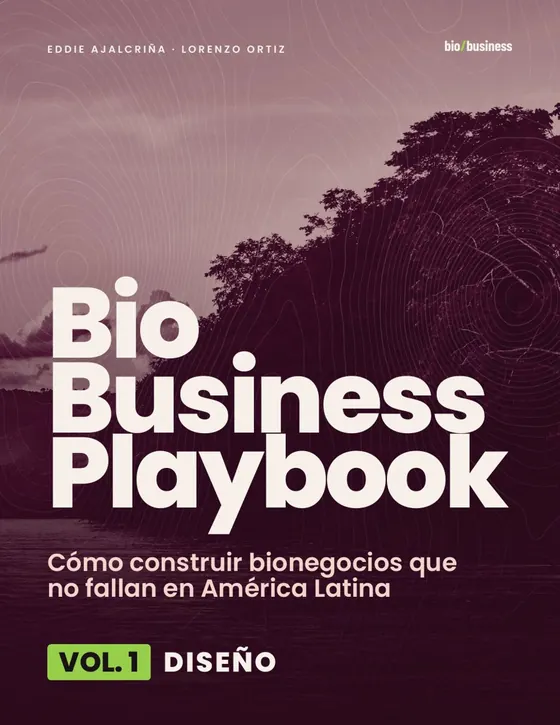
Design the operation and the offer of your biobusiness
A guide to turning a biodiversity resource into a well-specified, traceable product at the right cost.
Also available on
Eddie Ajalcriña and Lorenzo Ortiz216 pagesSpanish
Compare the three options
| Content | FreeOn the web and with your email | Book + toolsTo implement | BootcampTo do it with support |
|---|---|---|---|
| The 5 Steps on the web | Included | Included | Included |
| The 4 metrics and 2 online calculators | Included | Included | Included |
| 34-page sample | With your email | Included | Included |
| Tool 1 in Excel and the audit for each Step | With your email | Included | Included |
| Prompts to work with AI | 1 per Step | All 24 | All 24 |
| The complete digital book | Not included | Included | Included |
| 9-sheet Excel workbook, worksheets and guides | Not included | Included | Included |
| The Yarina case (camu camu) with all its figures | Not included | Included | Included |
| Five live weeks with the authors | Not included | Not included | Included |
| Review of your tools and mentoring | Not included | Not included | Included |
| Closing panel with buyers and funds | Not included | Not included | Included |
| Price | FreeIn SpanishStart with Step 01 (ES) | USD 22.99Only on this websitePay with  Buy (ES) | USD 290Founding cohort price, for the first 10 admitted participants who pay by December 15, 2026. After that, USD 390.See the bootcamp |
Free
On the web and with your email
- The 5 Steps on the web
- The 4 metrics and 2 online calculators
- 34-page sample: with your email
- Tool 1 in Excel and the audit for each Step: with your email
- Prompts to work with AI: 1 per step
Book + tools
To implement
- The 5 Steps on the web
- The 4 metrics and 2 online calculators
- 34-page sample
- Tool 1 in Excel and the audit for each Step
- Prompts to work with AI: all 24
- The complete digital book
- 9-sheet Excel workbook, worksheets and guides
- The Yarina case (camu camu) with all its figures
Buy (ES)Bootcamp
To do it with support
- The 5 Steps on the web
- The 4 metrics and 2 online calculators
- 34-page sample
- Tool 1 in Excel and the audit for each Step
- Prompts to work with AI: all 24
- The complete digital book
- 9-sheet Excel workbook, worksheets and guides
- The Yarina case (camu camu) with all its figures
- Five live weeks with the authors
- Review of your tools and mentoring
- Closing panel with buyers and funds
Prices in US dollars (USD). Mercado Pago charges the equivalent in Peruvian soles at S/ 3.50 per dollar; you see the exact amount before paying. The book with its tools is sold only on this website; Amazon sells the book only. The book and the checkout are in Spanish.
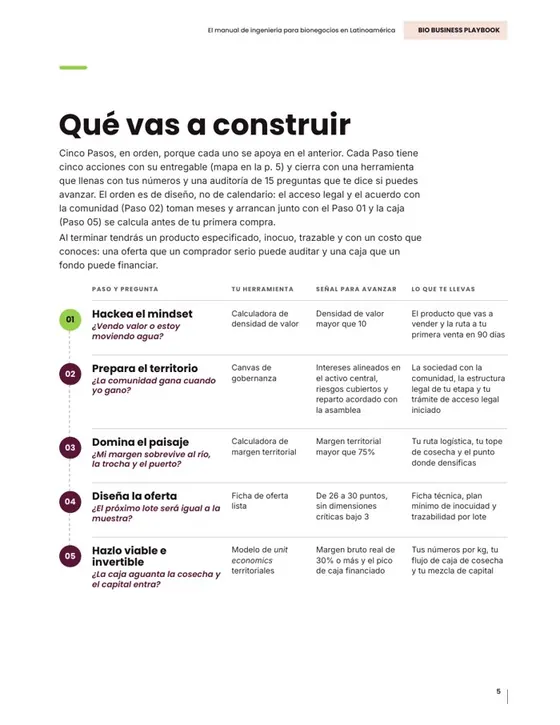
Five Steps and 25 actions
Each Step builds on the previous one, from the business model to capital. Each Step has five actions, each with a deliverable.
| Step | The question | What you take away |
|---|---|---|
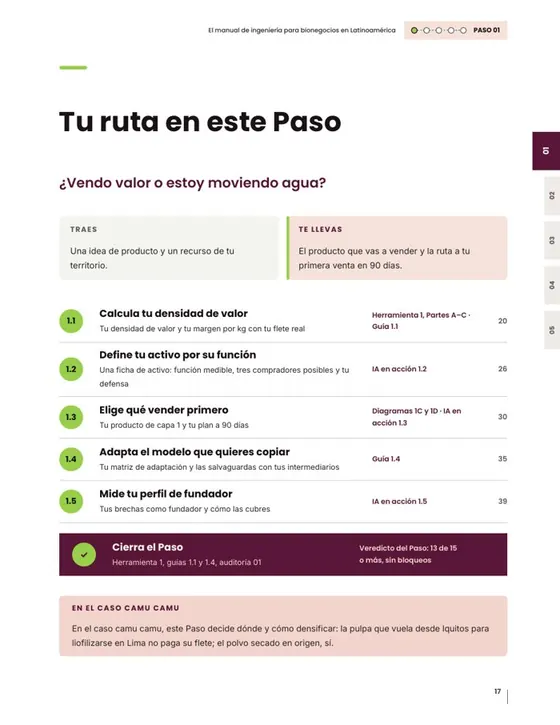
| 01 Hack the mindset | Am I selling value or moving water? | The product you will sell and the route to your first sale in 90 days. |
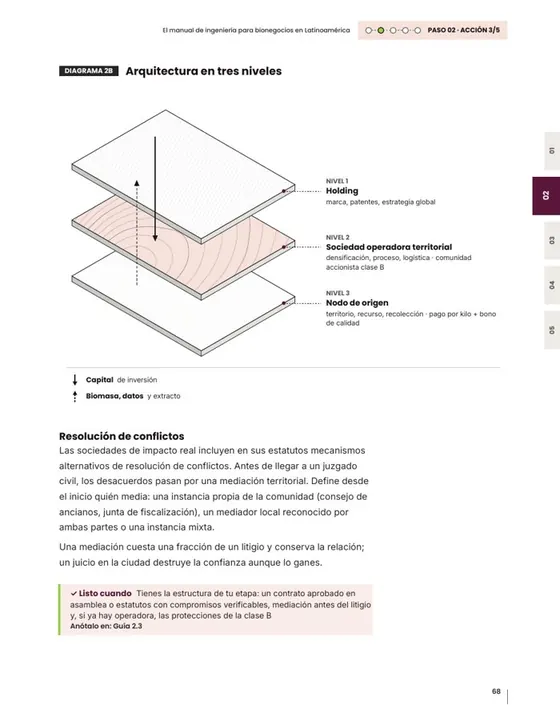
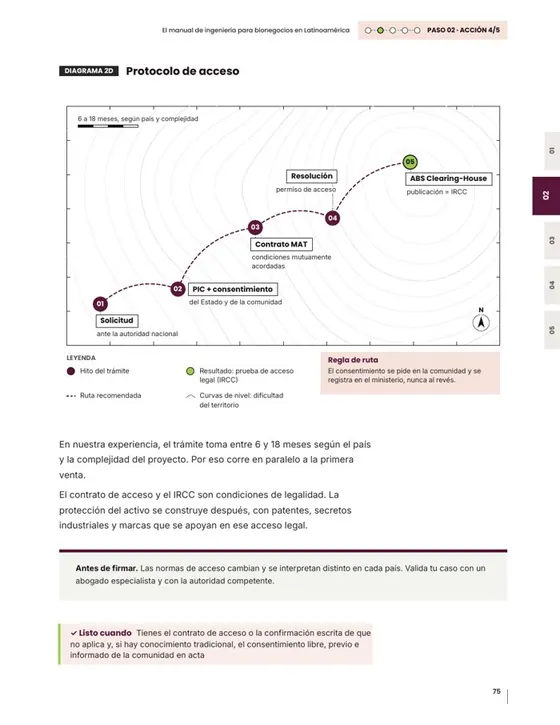
| 02 Prepare the territory | Does the community win when you win? | Your partnership with the community, the legal structure for your stage and your legal access process under way. |
| 03 Master the landscape | Does your margin survive the river, the dirt road and the port? | Your logistics route, your harvest cap and the point where you densify. |
| 04 Design the offer | Will the next batch match the sample? | Technical data sheet, minimum food safety plan and batch traceability. |
| 05 Make it viable and investable | Can your cash flow survive the harvest, and will the capital come in? | Your numbers per kg, your harvest cash flow and your capital mix. |
Four numbers that show whether a biobusiness holds up
Calculated per kg of final product. Example: the Yarina case (camu camu), with powder at USD 19.00 per kg FOB.
Value density (ES)
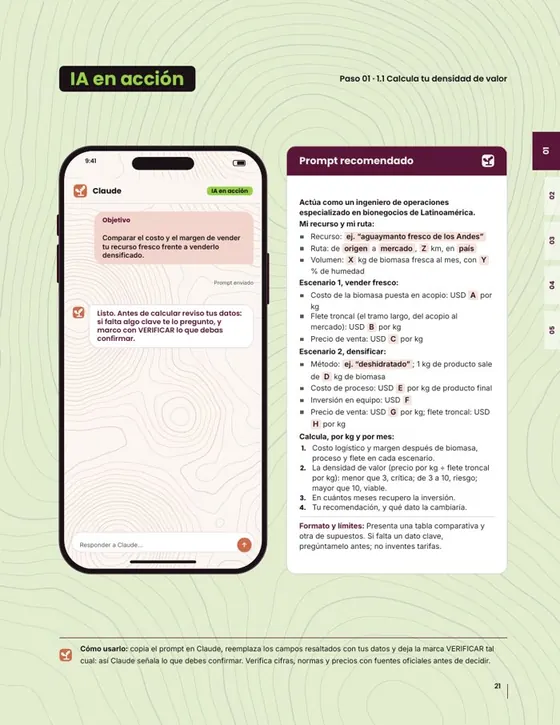
Price ÷ line-haul freight per kg. Are you selling value or moving water?
The Yarina case (camu camu)
Yarina Camu is a company in Pucallpa that buys organic camu camu from a producer association, dries it at origin on the day of the harvest and sells powder to Riverleaf, a US superfood brand, and to importers in the United States, Japan and Lima.
The case runs through the five Steps: where the water is removed, how value is shared with the community, what is measured in each batch and whether cash holds through the harvest.
- Powder per month, from about 82 t of fruit a year
- 800 kg
- Sales per month (Riverleaf: 57.7%)
- USD 15,850
- Operating profit per month (11.4%)
- USD 1,813
- Break-even per month
- 602 kg
- Cash low point, in May
- −USD 14,372
- Share of the margin for the community, paid when the buyer pays
- 10%
The companies are fictional. The figures come from reference assumptions with public sources as of October 2026. The full model, with assumptions, scenarios and month-by-month cash, comes in the book’s Excel workbook.
Pages from the book
Swipe to see 7 pages from the book
Upcoming volumes
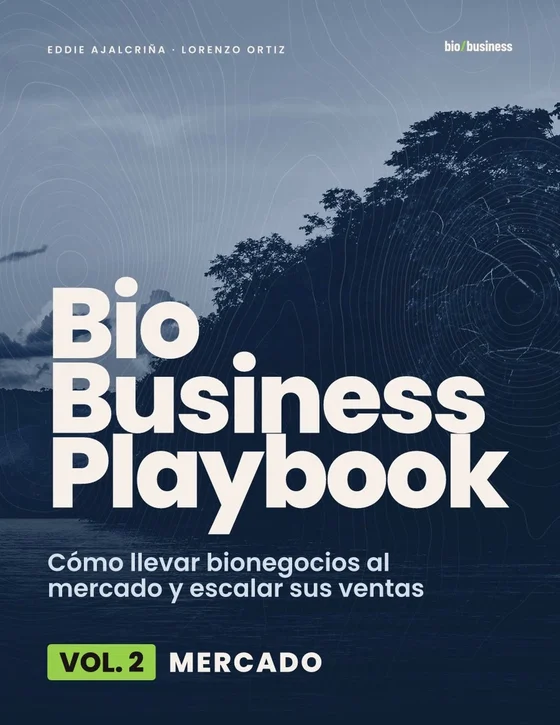 Vol. 2: MarketThe first buyer, crossing borders and destination regulations, and a brand that supports its price.
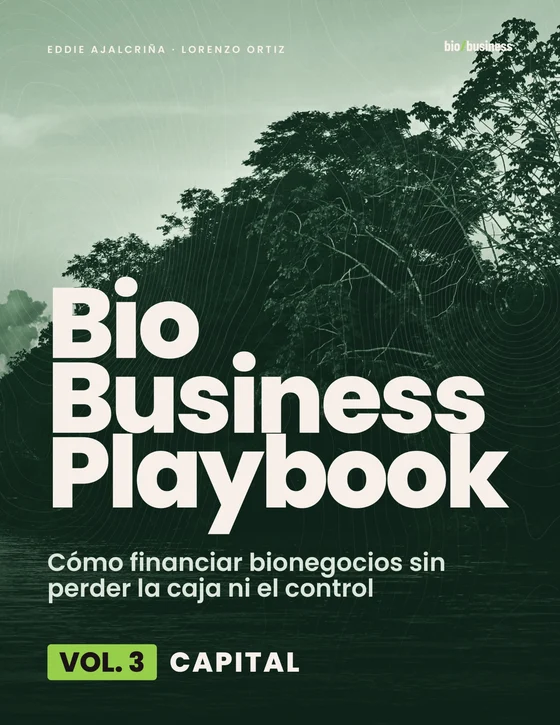 Vol. 3: CapitalInvestment readiness with the BIRF framework, debt and impact capital at scale, and corporate governance that includes the community.